Ki randizott Julius Caesar-szel?
Postumia Julius Caesar dátummal kelt, ? és ?. között
Postumia Julius Caesar dátummal kelt, ? és ?. között
Mamurra Julius Caesar dátummal kelt, ? és ?. között
Mucia Tertia Julius Caesar dátummal kelt, ? és ?. között
Lollia Julius Caesar dátummal kelt, ? és ?. között
Servilia Caepionis Julius Caesar dátummal kelt, ? és ?. között
Cossutia Julius Caesar dátummal kelt, ? és ?. között
Sempronia Julius Caesar dátummal kelt, ? és ?. között
Eunoë Julius Caesar dátummal kelt, ? és ?. között
Clodia Julius Caesar dátummal kelt, ? és ?. között
Tertulla Julius Caesar dátummal kelt, ? és ?. között
Nysa Julius Caesar dátummal kelt, ? és ?. között
VII. Kleopátra Julius Caesar dátummal kelt, és . között A korkülönbség 30 hónapig és 6 napig tartott volt.
Julius Caesar
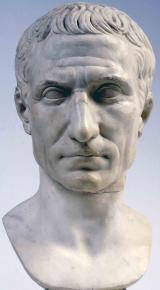
Gaius Julius Caesar (12 or 13 July 100 BC – 15 March 44 BC) was a Roman general, statesman, and author who was the dictator of the Roman Republic almost continuously from 49 BC until his assassination in 44 BC. A member of the First Triumvirate, he led the Roman armies through the Gallic Wars and defeated his political rival Pompey in Caesar's civil war. He consolidated power and proclaimed himself dictator for life in 44 BC, which contributed to the political conditions that led to the collapse of the Roman Republic and the emergence of the Roman Empire. For his role in these events, he is regarded as one of the most influential historical figures.
In 60 BC, Caesar, Crassus, and Pompey formed the First Triumvirate, an informal political alliance that dominated Roman politics for several years. Their attempts to amass political power were opposed by many in the Senate, among them Cato the Younger with the private support of Cicero. Caesar rose to become one of the most powerful politicians in the Roman Republic through a string of military victories in the Gallic Wars, completed by 51 BC, which greatly extended Roman territory. During this time, he invaded Britain and built a bridge across the Rhine. These achievements and the support of his veteran army threatened to eclipse the standing of Pompey. The alliance between Caesar and Pompey slowly broke down and, by 50 BC, Pompey had realigned himself with the Senate. With his command expiring and the Gallic Wars largely concluded, the Senate ordered Caesar to step down from his military command and return to Rome. In early January 49 BC, Caesar openly defied the Senate by crossing the Rubicon and marching towards Rome at the head of an army. This began Caesar's civil war, which he won, leaving him in a position of near-unchallenged power and influence in 45 BC.
After assuming control of government and pardoning many of his enemies, Caesar set upon a vigorous reform and building programme. He created the Julian calendar to replace the republican lunisolar calendar, reduced the size of the grain dole, settled his veterans in new overseas colonies, greatly increased the size of the Senate, and extended citizenship to communities in Spain and what is now northern Italy. In early 44 BC, he was proclaimed "dictator for life". Fearful of his power, domination of the state, and the possibility that he might make himself king, a group of senators led by Brutus and Cassius assassinated Caesar on the Ides of March (15 March) 44 BC. A new series of civil wars broke out and the constitutional government of the Republic was never fully restored. Caesar's great-nephew and adoptive heir Octavian, later known as Augustus, rose to sole power after defeating his opponents thirteen years later. Octavian then set about solidifying his power, transforming the Republic into the Roman Empire as its emperor.
Caesar was an accomplished author and historian; much of his life is known from his own accounts of his military campaigns. Other contemporary sources include the letters and speeches of Cicero and the historical writings of Sallust. Later biographies of Caesar by Suetonius and Plutarch are also important sources. Caesar is considered by many historians to be one of the greatest military commanders in history. His cognomen was subsequently adopted as a synonym for emperor; the title Caesar was used throughout the Roman Empire, and gave rise to modern descendants such as Kaiser and Tsar. He has frequently appeared in literary and artistic works.
Bővebben...Postumia
Julius Caesar
Postumia
Julius Caesar
Mamurra
Mamurra est un chevalier romain, intendant de Jules César dans les Gaules.
Il vivait au Ier siècle av. J.-C, amassa par ses exactions d’immenses richesses, et fit, à son retour, bâtir un palais magnifique sur le mont Cœlius.
Catulle a fait de sanglantes épigrammes contre ce favori de Jules César, justement décrié par ses rapines, par son luxe et par ses débauches. Dacier croit que la ville de Formies, qui, dans la satire V du livre Ier d’Horace, est appelée Mamurrarum urbs, lui appartenait. Mais il est plus probable que ce chevalier romain si décrié y avait seulement pris naissance, et que c’est un trait de satire qu’Horace lance en passant contre Mamurra. Formies dévient ainsi la ville des Mamurres parce que Mamurra l’a rendue célèbre par ses vices et ses déportements. Cela semble d’ailleurs plus dans le goût et le génie d’Horace, qui ne pouvait penser autrement que Catulle et tous les honnêtes gens de Rome sur ce fameux débauché.
Ce Mamurra est appelé ailleurs par Horace decoctor Formianus (le dissipateur, le mangeur de Formies), ce qui indique le cas qu’il en faisait. Il paraît que ce personnage était riche d’ailleurs, et avait à Rome une belle maison. Ce fut lui qui donna le premier, à Rome, l’exemple de faire incruster de marbre les murailles ; d’où cette sorte d’ornement prit en architecture le nom de décoration mamurrine.
Bővebben...Julius Caesar
Mucia Tertia
Mucia Tertia (fl. 79 – 31 BC) was a Roman matrona who lived in the 1st century BC. She was the daughter of Quintus Mucius Scaevola, the pontifex maximus and consul in 95 BC.
Around 79 BC, Mucia married Pompey, a leading and soon-to-be dominant figure in Roman politics. She was the mother of all three of Pompey's known children. Pompey divorced her in 61 BC, either for adultery or for political reasons. She subsequently married Marcus Aemilius Scaurus and remained active in Roman politics, leading peace talks between her son Sextus Pompey and Octavian in 39 BC and maintaining a relationship of mutual respect with Octavian in the years that followed.
Bővebben...Julius Caesar
Lollia
Lollia was an Ancient Roman noblewoman. She was the wife of Roman general Aulus Gabinius. She was also a mistress of Julius Caesar.
Bővebben...Julius Caesar
Servilia Caepionis

Servilia Caepionis (Kr. e. 107 – Kr. e. 42 után) az előkelő patrícius Servilia gens tagja, Quintus Servilius Caepio quaestor gyermeke, a hasonló nevű consul unokája volt.
Marcus Iunius Brutus anyjaként és Caesar szeretőjeként vonult be a történelembe. Suetonius szerint Iulius Caesar a sok híres szeretője közül őt szerette a legjobban. Másfél millió denariusra értékelték azt a gyöngyöt, amelyet Caesartól kapott.
Bővebben...Julius Caesar
Cossutia

Cossutia was a Roman woman who became engaged to Julius Caesar prior to his reaching adulthood. There has been debate among historians on whether the marriage actually occurred.
Bővebben...Julius Caesar
Sempronia

Sempronia war eine römische Aristokratin der späten Republik. Sie war die Frau des Decimus Iunius Brutus, Konsul des Jahres 77 v. Chr., und nach Sallust aktive Teilnehmerin – zumindest Mitwisserin – an der catilinarischen Verschwörung.
Bővebben...Julius Caesar
Eunoë

Eunoë Maura was the wife of Bogudes, King of Western Mauretania. Her name has also been spelled Euries or Euryes or Eunoa.
Bővebben...Julius Caesar
Clodia

Clodia (born Claudia; c. 94/95 BC), nicknamed Quadrantaria ("Quarter", from quadrantarius, the price of a visit to the public baths), Nola ("The Unwilling", from the verb nolo, in sarcastic reference to her alleged wantonness), Medea Palatina ("Medea of the Palatine") by Cicero (see below), and occasionally referred to in scholarship as Clodia Metelli ("Metellus's Clodia"), was one of three known daughters of the ancient Roman patrician Appius Claudius Pulcher.
Like many other women of the Roman elite, Clodia was very well-educated in Greek and philosophy, with a special talent for writing poetry. Her life, which was characterized by perpetual scandal, is immortalized in the writings of Marcus Tullius Cicero and, it is generally believed, in the poems of Gaius Valerius Catullus.
Bővebben...Julius Caesar
Tertulla
Tertulla was the wife of Marcus Licinius Crassus, "the richest man in Rome", and the mother of his two sons.
Bővebben...Julius Caesar
Nysa
Ниса (др.-греч. Νύσα) — дочь царя Вифинии Никомеда IV (по другим, видимо, устаревшим сведениям — Никомеда III), жившая в I веке до н. э.
Bővebben...Julius Caesar
VII. Kleopátra
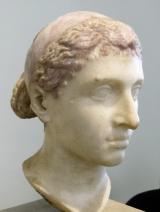
Cleopatra VII Thea Philopator (Koine Greek: Κλεοπάτρα Θεά Φιλοπάτωρ, lit. 'Cleopatra father-loving goddess'; 70/69 BC – 10 or 12 August 30 BC) was Queen of the Ptolemaic Kingdom of Egypt from 51 to 30 BC, and the last active Hellenistic pharaoh. A member of the Ptolemaic dynasty, she was a descendant of its founder Ptolemy I Soter, a Macedonian Greek general and companion of Alexander the Great. Her first language was Koine Greek, and she is the only Ptolemaic ruler known to have learned the Egyptian language, among several others. After her death, Egypt became a province of the Roman Empire, marking the end of the Hellenistic period in the Mediterranean, which had begun during the reign of Alexander (336–323 BC).
Born in Alexandria, Cleopatra was the daughter of Ptolemy XII Auletes, who named her his heir before his death in 51 BC. Cleopatra began her reign alongside her brother Ptolemy XIII, but a falling-out between them led to a civil war. Roman statesman Pompey fled to Egypt after losing the 48 BC Battle of Pharsalus against his rival Julius Caesar, the Roman dictator, in Caesar's civil war. Pompey had been a political ally of Ptolemy XII, but Ptolemy XIII had him ambushed and killed before Caesar arrived and occupied Alexandria. Caesar then attempted to reconcile the rival Ptolemaic siblings, but Ptolemy XIII's forces besieged Cleopatra and Caesar at the palace. Shortly after the siege was lifted by reinforcements, Ptolemy XIII died in the Battle of the Nile. Caesar declared Cleopatra and her brother Ptolemy XIV joint rulers, and maintained a private affair with Cleopatra which produced a son, Caesarion. Cleopatra traveled to Rome as a client queen in 46 and 44 BC, where she stayed at Caesar's villa. After Caesar's assassination, followed shortly afterwards by the sudden death of Ptolemy XIV (possibly murdered on Cleopatra's order), she named Caesarion co-ruler as Ptolemy XV.
In the Liberators' civil war of 43–42 BC, Cleopatra sided with the Roman Second Triumvirate formed by Caesar's heir Octavian, Mark Antony, and Marcus Aemilius Lepidus. After their meeting at Tarsos in 41 BC, the queen had an affair with Antony, which produced three children. Antony became increasingly reliant on Cleopatra for both funding and military aid during his invasions of the Parthian Empire and the Kingdom of Armenia. The Donations of Alexandria declared their children rulers over various territories under Antony's authority. Octavian portrayed this event as an act of treason, forced Antony's allies in the Roman Senate to flee Rome in 32 BC, and declared war on Cleopatra. After defeating Antony and Cleopatra's naval fleet at the 31 BC Battle of Actium, Octavian's forces invaded Egypt in 30 BC and defeated Antony, who committed suicide. After his death, Cleopatra reportedly killed herself, probably by poisoning, to avoid being publicly displayed by Octavian in a Roman triumphal procession.
Cleopatra's legacy survives in ancient and modern works of art. Roman historiography and Latin poetry produced a generally critical view of the queen that pervaded later Medieval and Renaissance literature. In the visual arts, her ancient depictions include Roman busts, paintings, sculptures, cameo carvings and glass, Ptolemaic and Roman coinage, and reliefs. In Renaissance and Baroque art, she was the subject of many works including operas, paintings, poetry, sculptures, and theatrical dramas. She has become a pop culture icon of Egyptomania since the Victorian era, and in modern times has appeared in the applied and fine arts, burlesque satire, Hollywood films, and brand images for commercial products.
Bővebben...